
10 August marks one hundred years since the first State Savings Bank was opened in 1919. It was one of the most important institutions where Lithuanian residents could accumulate their savings. What functions did this bank have? Was it popular? Who was in charge of it?
The history of the State Savings Bank
Its statutes were adopted on 4 August 1919. They essentially were a translation of the Russian statutes.
.jpg) The official purpose of this bank was to “receive deposits to accumulate interest and give it to residents to increase their savings”. The bank was centralised and the state was responsible for its commitments. It was under the Minister of Finance and he supervised it, but it was directly governed by the Board, consisting of the Chair and five Members. Before the Bank of Lithuania was established (1922) and took over the treasuries, Savings Bank branches were established next to them and after that – next to the bank and postal offices. 18 such branches were established until 1920 but only six of them were functioning. In 1920, 17 of them were already functioning.
The official purpose of this bank was to “receive deposits to accumulate interest and give it to residents to increase their savings”. The bank was centralised and the state was responsible for its commitments. It was under the Minister of Finance and he supervised it, but it was directly governed by the Board, consisting of the Chair and five Members. Before the Bank of Lithuania was established (1922) and took over the treasuries, Savings Bank branches were established next to them and after that – next to the bank and postal offices. 18 such branches were established until 1920 but only six of them were functioning. In 1920, 17 of them were already functioning.
Before adopting the litas, the Savings Bank did not perform any banking operations other than accepting deposits. After adopting litas, it started providing loans, making money transfers and other. However, it wasn’t very popular amongst the residents in the beginning. There were a couple of reasons for this: the deposit rate was low for a long time (3.6%), it had little material resources (some of the banks’ posters were even drawn by hand), and its branch locations were inconvenient (they were established in county centres, which made it difficult for village residents to reach them).
.jpg) However, from 1924 to 1928, the number of depositors started to increase due to an improving economic situation, large amounts of foreign money transfers and a decreasing interest on deposits in other banks. After 1931, the Savings Bank became especially popular. When the economic crisis blew over and the bank’s statutes were improved, the number of clients grew significantly. After the crisis, it was much safer to keep money in the Savings Bank and when the new statutes were adopted in 1932, residents were inclined to keep their deposits there even more.
However, from 1924 to 1928, the number of depositors started to increase due to an improving economic situation, large amounts of foreign money transfers and a decreasing interest on deposits in other banks. After 1931, the Savings Bank became especially popular. When the economic crisis blew over and the bank’s statutes were improved, the number of clients grew significantly. After the crisis, it was much safer to keep money in the Savings Bank and when the new statutes were adopted in 1932, residents were inclined to keep their deposits there even more.
From 1933, the bank started paying 3.6–4% interest rates for the deposits. More attention was paid to establishing new branches and improving conditions on their premises. In 1932, the bank’s branches were starting to be established near bigger postal offices and later – near AB Maistas factories. Therefore, the number of branches increased to 137 in 1939. 27 of them were near the Bank of Lithuania, 105 near postal offices and five near AB Maistas factories. Centres of larger counties had two and Kaunas had five Savings Bank branches. Klaipėda region had 11 branches in total.
In 1934, the statutes were improved once again, so the number of depositors continued to increase and reached record numbers in 1939 (the deposits amounted to almost 70 million litas). The Savings Bank became one of the main places to put your savings. The Bank of Lithuania and commercial banks were still in the lead based on the overall sum of deposits but the Savings Bank was catching up fast. From 1932 to 1939, the number of deposits in the Savings Bank was increasing two times faster than in other credit institutions. Meanwhile, the number of depositors tripled.
The Savings Bank used the deposits and capital to credit various clients. It credited municipalities that used this money to build schools, hospitals and improve the infrastructure as well as other credit institutions, private enterprises and residents. During the crisis, the government was forced to surrender its non-borrowing policy and the Savings Bank was the main buyer of government issued bonds. This way the Savings Bank helped to expand the weak financial market, increase its receptivity and maintain the securities’ rates quoted in the Kaunas stock exchange.
“Best young savers” competition
In 1930s, the number of the State Savings Bank’s depositors was rapidly increasing. Some of the reasons were an improving financial situation, much lower prices after the crisis and the increased purchasing power of litas. Another reason for the growth of the number of depositors is that saving became very popular amongst students and it was further stimulated by organising “Best young savers” competitions and presenting the winners with valuable rewards. For example, in 1935, the most active young savers were awarded four cameras, 117 watches and 202 books. In 1936, besides cameras, watches and books, students could also win briefcases, football and volleyball balls and one of the main prizes was...a traditional string instrument – kanklės!
State Savings Bank managers
.jpg) In 1919, an economist and banker, Stasys Digrys, was appointed the first manager of the Savings Bank. After coming back from Russia where he worked at the State Bank of Russia and took part in the activities of Lithuanian organisations in 191511917, he was a member of the Petrograd company of the Social Democratic Party of Lithuania (when its majority decided to join the Bolsheviks, he left the company and organised a new branch of the Social Democratic Party). He took part in the Petrograd Seimas and worked at the Lithuanian Council in Russia, he also handled the matters of Lithuanians returning to Lithuania. He remained the bank’s manager until 1920 when he was elected to the Constituent Assembly of Lithuania. It is unknown who came to this position after him, whereas in 1922, Juozas Dulskis was appointed the manager but there also isn’t much information about him.
In 1919, an economist and banker, Stasys Digrys, was appointed the first manager of the Savings Bank. After coming back from Russia where he worked at the State Bank of Russia and took part in the activities of Lithuanian organisations in 191511917, he was a member of the Petrograd company of the Social Democratic Party of Lithuania (when its majority decided to join the Bolsheviks, he left the company and organised a new branch of the Social Democratic Party). He took part in the Petrograd Seimas and worked at the Lithuanian Council in Russia, he also handled the matters of Lithuanians returning to Lithuania. He remained the bank’s manager until 1920 when he was elected to the Constituent Assembly of Lithuania. It is unknown who came to this position after him, whereas in 1922, Juozas Dulskis was appointed the manager but there also isn’t much information about him.
.jpg) He managed the bank until 1926 when Andrius Matulaitis was appointed; he was already a member of the bank’s board since 1922. He retained his position as a manager until his death in 1932.
He managed the bank until 1926 when Andrius Matulaitis was appointed; he was already a member of the bank’s board since 1922. He retained his position as a manager until his death in 1932.
.jpg) The biggest changes in the Savings Bank were carried out by Antanas Vaitkevičius, who replaced Matulaitis after his death. Vaitkevičius was an economist and worked at many important Lithuanian institutions: the Lithuanian Riflemen’s Union, the Lithuanian Cooperative Societies Union, and he was also a member of the Cooperative Bank’s Board as well as of the Central Discount Committee of the Bank of Lithuania. He also worked at the Ministry of Agriculture, the Credit Institutions and Cooperatives Inspection and was appointed as Manager of the State Savings Bank in 1932. During his time in office, the bank went through many changes and was greatly improved. He also worked in many public undertakings, organised the state lottery and so on. After the occupation, he was fired in 1940, then retreated to Germany and later resided in the US.
The biggest changes in the Savings Bank were carried out by Antanas Vaitkevičius, who replaced Matulaitis after his death. Vaitkevičius was an economist and worked at many important Lithuanian institutions: the Lithuanian Riflemen’s Union, the Lithuanian Cooperative Societies Union, and he was also a member of the Cooperative Bank’s Board as well as of the Central Discount Committee of the Bank of Lithuania. He also worked at the Ministry of Agriculture, the Credit Institutions and Cooperatives Inspection and was appointed as Manager of the State Savings Bank in 1932. During his time in office, the bank went through many changes and was greatly improved. He also worked in many public undertakings, organised the state lottery and so on. After the occupation, he was fired in 1940, then retreated to Germany and later resided in the US.
During the occupation, the bank continued to operate (under the conditions provided by the occupants, of course) and new managers were appointed. Interestingly, during the Nazi occupation, Gediminas Galvanauskas (Galva), the brother of a former Prime Minister of Lithuania, Ernestas Galvanauskas, was appointed to the position of Manager.
The State Savings Bank building
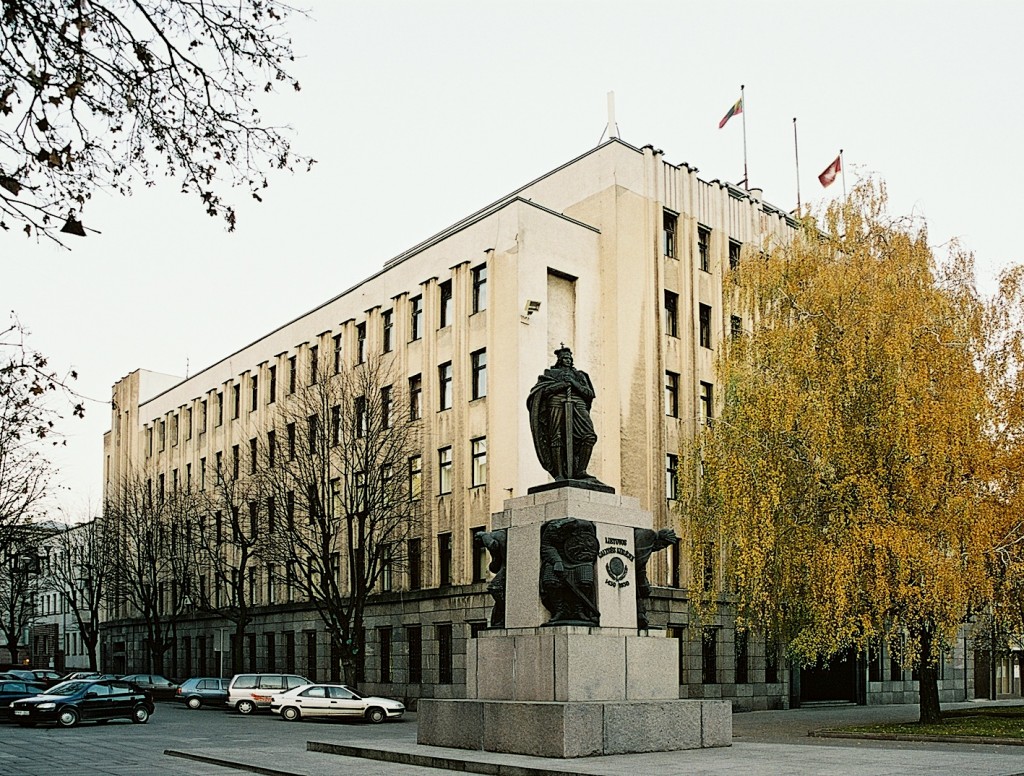 In 1938–1940, at the intersection of Laisvės alėja and L. Sapiegos g. (Laisvės alėja 96), the central building of the State Savings Bank was built in the style of functionalism, designed by famous architects Arnas Funkas, Adolfas Lukošaitis and Bronius Elsbergas. The 6-story "skyscraper" became the last prominent architectural accent in Laisvės alėja, which influenced the city’s further urban development style. Sadly, the building remained unopened until the occupation. The building was supposed to host the Trade Department, the Bureau of Statistics and other governmental institutions alongside the State Savings Bank. It is three 6 and 5-story buildings in one that form a partly enclosed courtyard. The building features geometrical forms and a laconically planned and compositional structure. It is also remarkable for its pneumatic mail tube and a safe in its basement. The revolving door at its main entrance was the only one of its kind in Kaunas during the interwar period. However, not a lot of the building’s original interior features have remained to this day.
After World War II, the building hosted the Kaunas Executive and the Communist Party Committees, nowadays it is home to Kaunas City Municipality.
