
Julija Beniuševičiūtė-Žymantienė Žemaitė (1845–1921), Lithuanian writer, educator and public figure, was the only real woman to be featured on litas banknotes issued after 1990. However, truth be told, it happened almost by accident.
The idea to issue the litas emerged in 1989 when Lithuania was still part of the Soviet Union. That is when the creation of Lithuanian money also started, although no one really knew where to begin, how the money should look like, where it will be printed and so on. Quite a lot of discussion was held on what should be featured on litas banknotes. There were competitions announced and a lot of suggestions were considered, although many of them were ruled out (e.g. portraits of the Grand Dukes of Lithuania, despite their significant role in Lithuania’s history, were eliminated because there are actually no real portraits of them).
.jpg) In 1990, it was decided that litas banknotes should feature people who had led Lithuania towards 16 February 1918, i.e. personalities that lived in the 19th–20th centuries. A list of them was announced and confirmed, however, it included no women. This oversight was noticed by the Lithuanian Australian Kęstutis Lynikas who was then consulting Lithuanians and had a lot of experience in money production. He pointed out that if Lithuania issued banknotes featuring only men, it was going to receive major backlash from the global feminist movement. To prevent this, it was decided to feature the writer Žemaitė but only on the 1 litas banknote (it was first supposed to feature symbolic figures, such as a peasant with a straw hat and a reed pipe). In 1993, 1, 2 and 5 litas denominations were released as coins, thus there were no banknotes envisaged for them yet, since their creation was postponed. Finally, they were printed at Thomas de La Rue printing house in England and entered into circulation in 1994. The design was created by Giedrius Jonaitis. He repainted the portrait of Žemaitė from a well-know photo taken in the early 20th century and the printing house’s engraver masterly engraved it. Both the painting and the engraving were done splendidly, thus this was one of the most successful portraits to be placed on a litas banknote. However, probably due to the fact that the banknote was designed in a hurry or because of other reasons, it had some minor logic errors. A rather strange choice was to feature Palūšė Church on the reverse when it had nothing in common with Žemaitė who talked quite openly about being an atheist, and it is even doubtful whether she had ever been to Palūšė at all. Another inaccurate detail, although not that obvious, can be found on the obverse, right under the writer’s portrait. It is the inscription J. ŽEMAITĖ as if it was her real surname. In this case, probably because of an oversight, only the first letter of her name and her pen name were provided without the surname or other specifications.
In 1990, it was decided that litas banknotes should feature people who had led Lithuania towards 16 February 1918, i.e. personalities that lived in the 19th–20th centuries. A list of them was announced and confirmed, however, it included no women. This oversight was noticed by the Lithuanian Australian Kęstutis Lynikas who was then consulting Lithuanians and had a lot of experience in money production. He pointed out that if Lithuania issued banknotes featuring only men, it was going to receive major backlash from the global feminist movement. To prevent this, it was decided to feature the writer Žemaitė but only on the 1 litas banknote (it was first supposed to feature symbolic figures, such as a peasant with a straw hat and a reed pipe). In 1993, 1, 2 and 5 litas denominations were released as coins, thus there were no banknotes envisaged for them yet, since their creation was postponed. Finally, they were printed at Thomas de La Rue printing house in England and entered into circulation in 1994. The design was created by Giedrius Jonaitis. He repainted the portrait of Žemaitė from a well-know photo taken in the early 20th century and the printing house’s engraver masterly engraved it. Both the painting and the engraving were done splendidly, thus this was one of the most successful portraits to be placed on a litas banknote. However, probably due to the fact that the banknote was designed in a hurry or because of other reasons, it had some minor logic errors. A rather strange choice was to feature Palūšė Church on the reverse when it had nothing in common with Žemaitė who talked quite openly about being an atheist, and it is even doubtful whether she had ever been to Palūšė at all. Another inaccurate detail, although not that obvious, can be found on the obverse, right under the writer’s portrait. It is the inscription J. ŽEMAITĖ as if it was her real surname. In this case, probably because of an oversight, only the first letter of her name and her pen name were provided without the surname or other specifications.
Maybe because this was the only banknote to feature a woman, or maybe since 1 litas banknotes were used the most, it is arguably the most memorable one and people feel the most nostalgic towards it. Despite the errors, the banknote was never reissued and was in circulation until 2007 when 1, 2 and 5 litas banknotes were completely replaced by coins of the same denominations and no women were featured on them.
.jpg) What is the general situation regarding women on Lithuanian money? Where and which women were featured on modern or historic banknotes and coins? Sadly, it has to be said that very few women have ever been depicted on Lithuanian money. There were no women on coins in the Grand Duchy of Lithuania (of course, this was determined by the fact that only the rulers used to be featured on coins and they were exclusively men). During the interwar period, there were several women featured but they were mostly pictured as allegorical figures. The only real person was Duchess Birutė who was on the 100 litas banknote issued in 1922 (her portrait was the fruit of imagination of the artist Adomas Varnas). However, nowadays it is still being argued whether Birutė was a historic figure or more of a legend.
What is the general situation regarding women on Lithuanian money? Where and which women were featured on modern or historic banknotes and coins? Sadly, it has to be said that very few women have ever been depicted on Lithuanian money. There were no women on coins in the Grand Duchy of Lithuania (of course, this was determined by the fact that only the rulers used to be featured on coins and they were exclusively men). During the interwar period, there were several women featured but they were mostly pictured as allegorical figures. The only real person was Duchess Birutė who was on the 100 litas banknote issued in 1922 (her portrait was the fruit of imagination of the artist Adomas Varnas). However, nowadays it is still being argued whether Birutė was a historic figure or more of a legend.
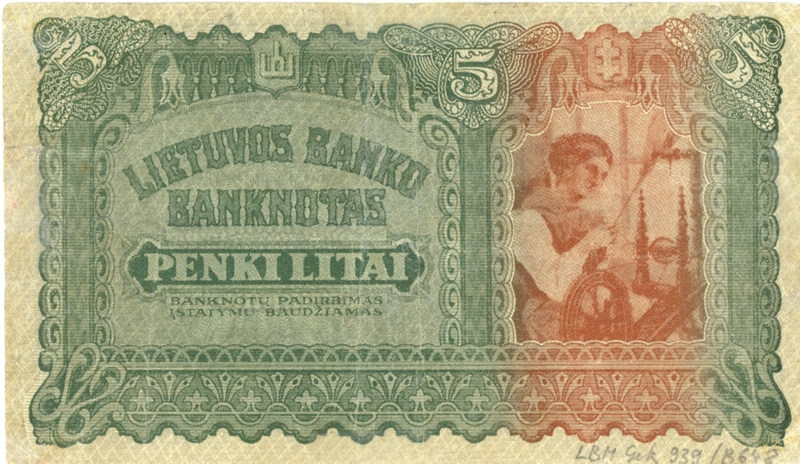
Women as symbols and allegorical figures can be seen on some banknotes issued during the interwar period: a yarn spinner on the 5 litas banknote issued in 1922, one of the two figures on the 1000 litas banknote issued in 1924 (next to the woman – various things symbolising the country, trade and agriculture), a woman in a folk costume holding a cornucopia, who symbolised Lithuania as the land of agriculture and a modernising country on the 100 litas banknote issued in 1928 (by the way, a real person posed for this portrait – it was Elena, the wife of the Lithuanian diplomat Edvardas Turauskas). In part, the reverse of the 20 litas banknote issued in 1929 could also be counted as featuring women, as it depicts the statue of Liberty (girl – angel?).
.jpg)
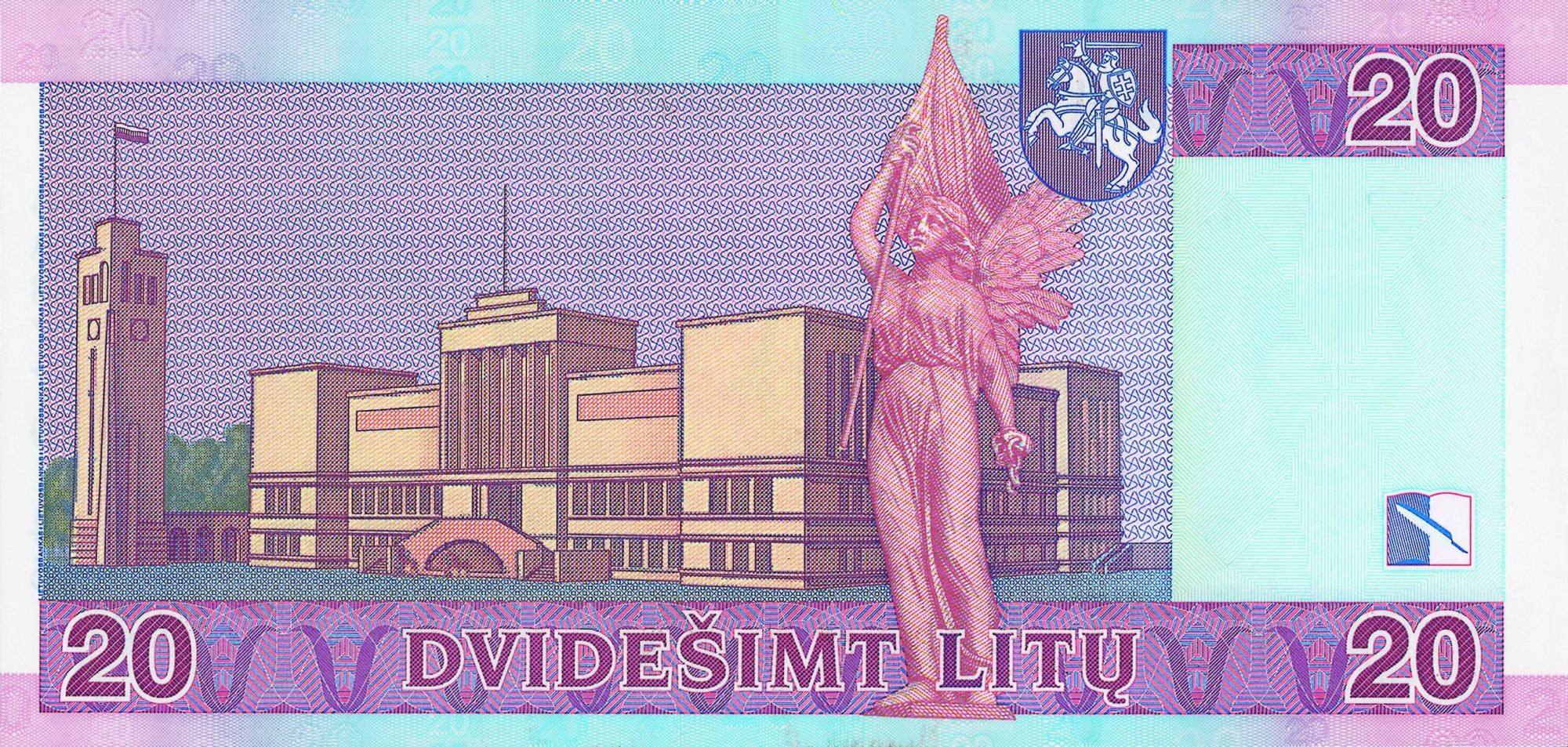
The same situation was with litas banknotes that were in circulation after 1990. Although we already presented the 1 litas banknote with Žemaitė, the symbolic portrayal of women was in an even poorer situation than during the interwar period. On the reverse of the 5 litas banknote issued in 1994, we can see a drawing of a sculpture called “Lithuanian School in 1864–1904” (also known as “Hardship School”). It was created by Petras Rimša in 1906 and depicts a woman sitting next to a spinning wheel and reading with a child, whereas on the reverse of the 20 litas banknote – the already discussed statue of Liberty in Kaunas. And that was it.
.jpg)
The Bank of Lithuania’s collection of commemorative and collector coins is truly abundant. Since 1993, the Bank of Lithuania has released more than 100 sets of litas and euro coins. Amongst them, one can also see coins dedicated to specific women. Unfortunately, there are only a few of them to this day. The first of such coins was released only in 2006. This is a silver 50 litas coin dedicated to the Uprising of 1831 and the 200th birth anniversary of its heroine Emilija Pliaterytė, whereas in 2011 a silver 50 litas coin was dedicated to the 150th birth anniversary of the writer and public figure Gabrielė Petkevičaitė-Bitė. Thus far, there are no more coins specifically dedicated to women. Truth be told, one other real woman can be seen on a collector coin. The reverses of gold 25 litas and silver 50 litas coins released in 2013, dedicated to the 25th anniversary of the establishment of the Lithuanian Sąjūdis (Reform Movement), feature a girl holding a Lithuanian flag. This girl is Leokadija Juškienė as she was pictured in the famous photo taken by Zinas Kazėnas. This special moment, immortalised by the photographer, became the symbol of the desire for Lithuania’s independence and freedom. A fragment of this photo was used by the artist Rytas Jonas Belevičius. However, the woman’s name is not mentioned on the coin. Some other women can be seen on collector coins but, once again, they are just symbolic, allegorical figures or images of other artworks.
.jpg)
.jpg)
(1).jpg)
Why are there so few women featured on Lithuanian money? It is hard to tell for certain. Probably the main reason is that throughout the Lithuanian history, in politics, culture and other areas men would usually overshadow women, and until the 20th century the role that women played was altogether deliberately underestimated. This situation is poor not only in Lithuania. There are not many countries that issue money depicting women who are not politicians or who lived later than in the 20th century. Surely, the situation is now changing and the role that women play nowadays is by no means inferior to that of men. Therefore, we have no doubt that we will see many more of them on future money. Although even now, a lot of Lithuanian women, who deserve being featured on collector coins at the very least, are awaiting their turn: noblewomen of the Grand Duchy of Lithuania, writers, artists, theatre directors, politicians, etc. Their turn will come very soon.
