
The discussions on introducing the national currency started as early as in 1919. On 12 August, at a meeting held by the Cabinet of Ministers, it was decided to name the national currency muštinis. In this meeting, the format, colours, watermarks and the overall design of the banknotes were discussed. It was planned to issue 9 denominations of muštinis: 1/2, 1, 5, 10, 25, 50, 100, 500 and 1000, all of which had to be decorated with the ornaments of Lithuanian sashes and feature agricultural and nature motifs as well as Vytis in their watermarks. Artists Antanas Žmuidzinavičius and Adomas Galdikas had to create the designs of the banknotes. It was decided to print the new banknotes in Sweden. However, these plans were not meant to come true, so the adoption of national money was delayed for three more years.
On 9 August 1922, the Constituent Assembly of Lithuania passed the Law on Currency which announced the adoption of litas that was backed by gold. The adoption process of the new currency was assigned to the Bank of Lithuania whose law was passed on 11 August 1922. The government granted the bank exclusive rights to issue banknotes for 20 years and gave 3 million gold roubles received from Soviet Russia under the peace treaty of 12 July 1920 for the initial cover of the banknotes. On 2 October 1922, a new monetary unit was released into circulation - litas. Its gold content was set at 0.150462 g of pure gold (that means that the exchange rate of litas to the US dollar was 10:1). In the meantime, while waiting for the permanent banknotes ordered at Andreas Haase printing house in Prague to be produced, it was decided to urgently issue temporary money. An agreement was signed with Otto Elsner printing house in Berlin to print these banknotes, as it already printed German and Estonian marks. The printing house already had some banknote designs, base patterns and other parts in stock. All that had to be done was to choose the designs and supplement them with text and the Vytis symbol. Printing plates were made in 3 days. On 20 September, the temporary banknotes arrived in Kaunas. Due to the order’s urgency, the format of the banknotes was small and the design was simple.
.jpg)
.jpg)
.jpg)
.jpg)
.jpg)
.jpg) The Bank of Lithuania’s permanent banknotes of 12 denominations were printed in Prague, at Andreas Haase printing house. The agreement to print the Bank of Lithuania’s banknotes was signed with Andreas Haase company on 29 August 1922. 1, 2, 5, 10, 20 and 50 centas banknotes were issued into circulation in the beginning of November, while 1 and 2 litas banknotes – in the beginning of December 1922. 10-litas banknote followed in February, while 50-litas banknote was issued in March 1923. Their designs were created by an artist Adomas Varnas.
The Bank of Lithuania’s permanent banknotes of 12 denominations were printed in Prague, at Andreas Haase printing house. The agreement to print the Bank of Lithuania’s banknotes was signed with Andreas Haase company on 29 August 1922. 1, 2, 5, 10, 20 and 50 centas banknotes were issued into circulation in the beginning of November, while 1 and 2 litas banknotes – in the beginning of December 1922. 10-litas banknote followed in February, while 50-litas banknote was issued in March 1923. Their designs were created by an artist Adomas Varnas.
.jpg)
.jpg)
.jpg)
.jpg)
.jpg)
.jpg)
.jpg)
.jpg)
.jpg)
.jpg)
.jpg)
.jpg)
In 1924, the amount of money in circulation had significantly increased, therefore the Bank of Lithuania, to make payments and transactions easier, decided to issue banknotes of higher denominations - 500 and 1,000 litas. During the meeting of the General Council, it was decided to print the designs of Vilius Jomantas and Adomas Galdikas.
When the Bank of Lithuania announced a tender to print the banknotes, the most famous companies and printing houses in the world submitted their tenders - the American Banknote Co. (the US), Andreas Haase (Czechoslovakia) and Bradbury, Wilkinson & Co. Ltd. (England). The latter was the one chosen. The Bank of Lithuania’s request was to protect the banknotes against counterfeiting as well as possible, so “money” paper with watermarks, colourised fibres and an intricate, colourful drawing was used. Later on, a vertical 20 mm width security thread of red and blue silk fibres was added to one side of the banknotes. 500 litas banknotes were issued into circulation on 28 September 1925 and 1,000 litas banknotes - on 23 February of the following year.


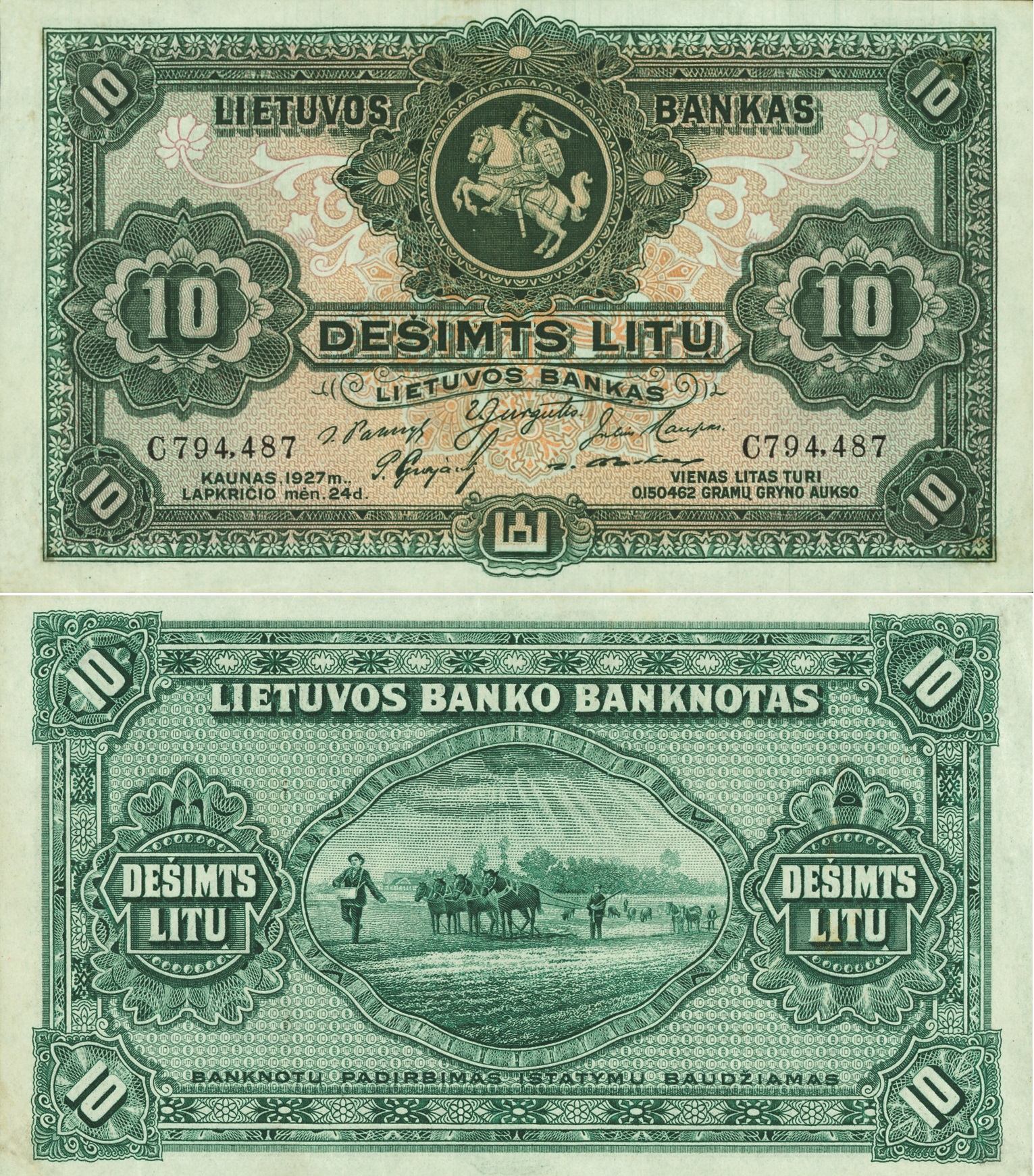
In 1927-1930, new issues of banknotes were released. The new banknotes of 5, 10, 20, 50 and 100 litas were printed at Bradbury, Wilkinson & Co. Ltd. company which was quite progressive. The designs of the new banknotes were created by famous artists: Adomas Galdikas, Vilius Jomantas and Antanas Žmuidzinavičius. Since money represents the country and reflects its ideology, the young Republic of Lithuania’s banknotes were full of national symbols, portraits of dukes and public figures as well as landscapes of the largest cities and their coats of arms. The banknotes featured symbols reflecting the national spirit and the national identity - a sower, a yarn spinner, a raftsman, a Lithuanian girl in traditional attire, ornamentation of Lithuanian folk art, small folk architecture, motifs of fabrics and sash patterns. The designs submitted by artists were considered and approved by the General Council of the Bank of Lithuania.
.jpg)
.jpg)
.jpg)
After the Soviet Union occupied Lithuania on 15 June 1940, a reorganisation was soon started. In August, the Bank of Lithuania was nationalised, and in November, Soviet money - chervonets, rouble and kopeyka - was issued into circulation. Until 25 March 1941, they were in circulation alongside litas. In April 1941, the Chairman of the Gosbank ordered to burn all litas banknotes that were collected from the residents or were stored at banks.
