
Ignacy Julian Cejzyk, a grandson of a Lithuanian military officer, was born in 1779 in the Polish-Lithuanian Commonwealth (the Podlaskie Voivodeship, which later belonged to the Grodno Governorate), in the city of Lyskovo (modern day Belarus). He came from a family of petty nobility, so he was a patriot of the Polish-Lithuanian Commonwealth from an early age. Therefore, when the final partition of the Commonwealth happened in 1795 and his homeland became part of the Russian Empire, he, as did many of his peers, became an active adversary of the occupants. This was the reasoning behind his later activities.
Cejzyk graduated from secondary school in Vilnius and in 1798 started his studies at the Faculty of Arts of Vilnius University, when the famous painter Franciszek Smuglewicz was the faculty’s dean. Cejzyk studied drawing and fine arts, he was also interested in sculpture.
After studies he left, but soon returned to Vilnius, to the same university, where he started working as a calligrapher, decorating university graduation diplomas as well as other documents, It was a well-paid but, likely, very boring job, because he not only decorated official documents, but also started falsifying city theatre tickets (which had no designated seating indicated on them at the time) and selling them to students. This is how his career as a counterfeiter started.
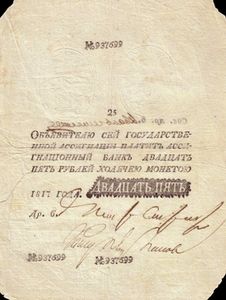 He didn’t get caught with counterfeit tickets and he continued his studies, lived in Warsaw and got married there, and later lived in various cities of the former Commonwealth. While travelling, he passed the time creating art. He made children’s toys out of wood or clay, as well as little sculptures out of amber or ivory. Yet he couldn’t get rich for the life of him. And that wasn’t only because no one bought his art – according to those who knew him, he was very kind-hearted and often gave away his savings to poor neighbours or acquaintances. In 1811, he moved near Lutsk (modern day Ukraine) and started counterfeiting money. His knowledge of calligraphy and painting, gained in Vilnius, was a great aid in this venture. He didn’t counterfeit money only to get rich; he also naively believed that he would thus contribute to the economic collapse of the Russian Empire. Napoleon’s France was already doing this by printing fake Russian assignation roubles. Cejzyk saw a fake assignation at the market and it inspired him to start his own venture.
.jpg) In the beginning, he printed banknotes of the older design because they had less security features, but when they were taken out of circulation, he started printing those of the newer design as well. He did this alongside his brother and his wife’s brother, who were responsible for providing the right materials, logistics and distribution (they would buy expensive goods with counterfeit money, then sell those goods and thus get real money). They were printing impressive amounts of those banknotes. Later calculations showed that in 1817, the older design counterfeit banknotes alone were so widespread that Russia’s government had to issue a new series, because there were simply too many counterfeit banknotes in circulation.
In the beginning, he printed banknotes of the older design because they had less security features, but when they were taken out of circulation, he started printing those of the newer design as well. He did this alongside his brother and his wife’s brother, who were responsible for providing the right materials, logistics and distribution (they would buy expensive goods with counterfeit money, then sell those goods and thus get real money). They were printing impressive amounts of those banknotes. Later calculations showed that in 1817, the older design counterfeit banknotes alone were so widespread that Russia’s government had to issue a new series, because there were simply too many counterfeit banknotes in circulation.
The counterfeiting was quite successful, especially when Russia was at war with Napoleon (in 1812). There was plenty of fake money at the time, and everything was chaotic in general, so no one really looked for counterfeiters. An interesting fact is that it is known that Cejzyk supported Napoleon’s ideas and resistance against Russia, so he was printing banknotes in hopes of disrupting the country, but he also supported the resistance movement.
However, the counterfeiters were caught in 1814. They were arrested at the scene of the crime, in a little house where they were printing the banknotes. Alongside counterfeiting equipment, there were also more than 60,000 fake roubles found. An impressive amount for those times! 2 roubles could buy you a calf! The exact amount of money that Cejzyk and his group printed and entered into circulation is unknown.
When the criminals were arrested, they were put in Slutsk prison at first and later moved to Minsk, where they stayed for almost 5 years. But they managed to escape. This wasn’t too difficult, because prison wardens really liked Cejzyk and he was allowed to come and go as he pleased. On these walks, he falsified documents for him and his accomplices and all of them escaped to Vienna in 1819, where they continued their work as counterfeiters (this time they falsified local currency guldens).
The Russian Empire’s police started searching for them in the Austro-Hungarian Empire. And this is when Cejzyk had another brilliant idea. He decided to return to Russia, as nobody was searching for him there anymore. He falsified his documents and returned to his homeland Podlaskie under another surname, where he continued his trade. However, this time it was very short-lived. His kind heart was his downfall once again, because printing money for his own use wasn’t enough, he was also giving banknotes away to the poor. This charitable work didn’t go unnoticed by the police and Cejzyk found himself in the Minsk prison once again in 1821, where he managed to win over the wardens for a second time. Only this time it was with his talent. He was allowed to work with clay in his prison cell and he made some beautiful art pieces, he even discovered a new clay moulding technique. As he was gifting his creations to the wardens, they let him leave the prison freely again and he escaped once again.
Counterfeit money started spreading throughout the Russian Empire once more. Quite a lot of it had also spread in Lithuania’s territory because the husband of Cejzyk’s sister was distributing fake assignations here. When he was distributing them around Grodno, he was recognised by his former servant and so the accomplices were caught once again in 1828 and were put on trial at Grodno’s court. Cejzyk pleaded guilty and even offered to become a consultant on money making because, according to him, the real banknotes were of a much poorer quality than those that he printed. However, his offer was refused and he was exiled to Western Siberia, to the city of Tobolsk. To make matters even worse, he was stripped of his nobility title and divorced from his wife by court.
.jpg) In Tobolsk, he became famous as an artist and even got a job in a glass factory where he was paid quite well. He got married once again, had two children and would have probably lived happily ever after, if not for his old habits. He started counterfeiting assignations again. This time, he was quickly caught and received a hard labour sentence in 1846 – he was sent to a silver mine in Sakha. For a few years, he had to mine silver and tin alongside other convicts, but the admirers of his art succeeded in their efforts to save Cejzyk from these duties. Therefore, his punishment was reduced to exile without hard labour. He settled in Verkhneudinsk (modern day Ulan-Ude, Buryatia, Russia) where he engaged in the arts for a while and even attempted to make fake coins, but soon abandoned this idea and continued to lead a peaceful life as an old man. He moved with his family to Irkutsk in 1857 and died there in 1858.
In Tobolsk, he became famous as an artist and even got a job in a glass factory where he was paid quite well. He got married once again, had two children and would have probably lived happily ever after, if not for his old habits. He started counterfeiting assignations again. This time, he was quickly caught and received a hard labour sentence in 1846 – he was sent to a silver mine in Sakha. For a few years, he had to mine silver and tin alongside other convicts, but the admirers of his art succeeded in their efforts to save Cejzyk from these duties. Therefore, his punishment was reduced to exile without hard labour. He settled in Verkhneudinsk (modern day Ulan-Ude, Buryatia, Russia) where he engaged in the arts for a while and even attempted to make fake coins, but soon abandoned this idea and continued to lead a peaceful life as an old man. He moved with his family to Irkutsk in 1857 and died there in 1858.
.jpg) Ignacy Cejzyk remained famous after his death not only for his illegal activities, but also as an artist. Even though he was an amateur sculptor, his works were appreciated while he was alive and their value grew even more after his death. Ironically, his art pieces were counterfeited on a massive scale in Transbaikal and sold as his. Quite a paradox, isn’t it?
Ignacy Cejzyk remained famous after his death not only for his illegal activities, but also as an artist. Even though he was an amateur sculptor, his works were appreciated while he was alive and their value grew even more after his death. Ironically, his art pieces were counterfeited on a massive scale in Transbaikal and sold as his. Quite a paradox, isn’t it?
There aren’t a lot of Cejzyk’s art pieces that have survived to this day, some of them are displayed in Russia’s museums (including the Hermitage Museum). There are also some at the Lithuanian National Museum of Art and the M. K. Čiurlionis National Museum of Art.


