
The issue of the introduction of a national currency arose as far back as 1919. On 12 August, at a meeting of the Cabinet of Ministers, the new monetary unit was given the name of “muštinis”. Bankotes worth ½, 1, 5, 10, 25, 50, 100, 500 and 1000 muštinis were to be issued. The patterns on the paper money were to be designed by the artists A. Žmuidzinavičius and A. Galdikas, with printing to be carried out in Sweden. However, the introduction of a national currency was eventually postponed for three more years.
On 9 August 1922, the Constituent Seimas passed a law on a new monetary unit, declaring the introduction of gold-backed currency – the litas. The Bank of Lithuania was authorised to issue the litas and was granted a concession on the issue of the notes for 20 years. In the initial stage, the bank was appropriated 3 million gold roubles, received from Soviet Russia in accordance with the peace treaty of 20 July 1920. The litas came into use on 2 October 1922, and was equal to 0.150462 g in pure gold (i.e. the litas to US dollar exchange rate was 10:1). First, in accordance with an agreement signed in April 1922, interim banknotes were issued at the Otto Elsner printing house in Berlin. The urgency of the order explains the simple designs and small size of the notes. The interim banknotes were brought to Kaunas on 20 September.
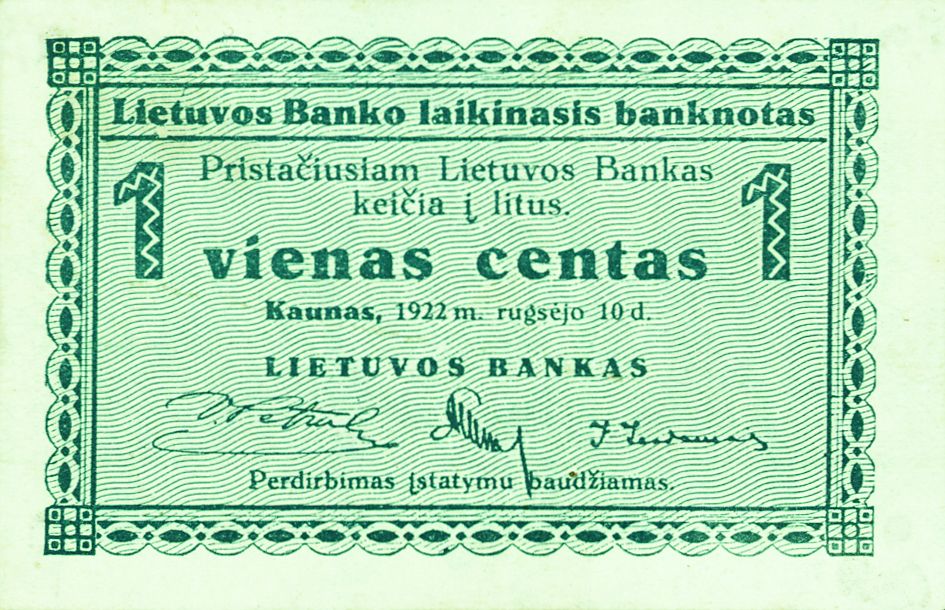
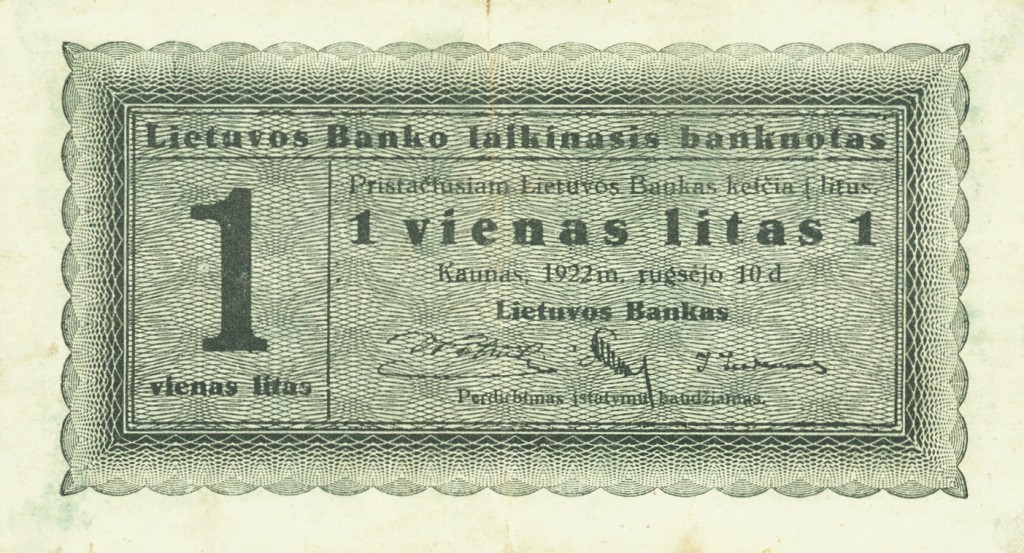
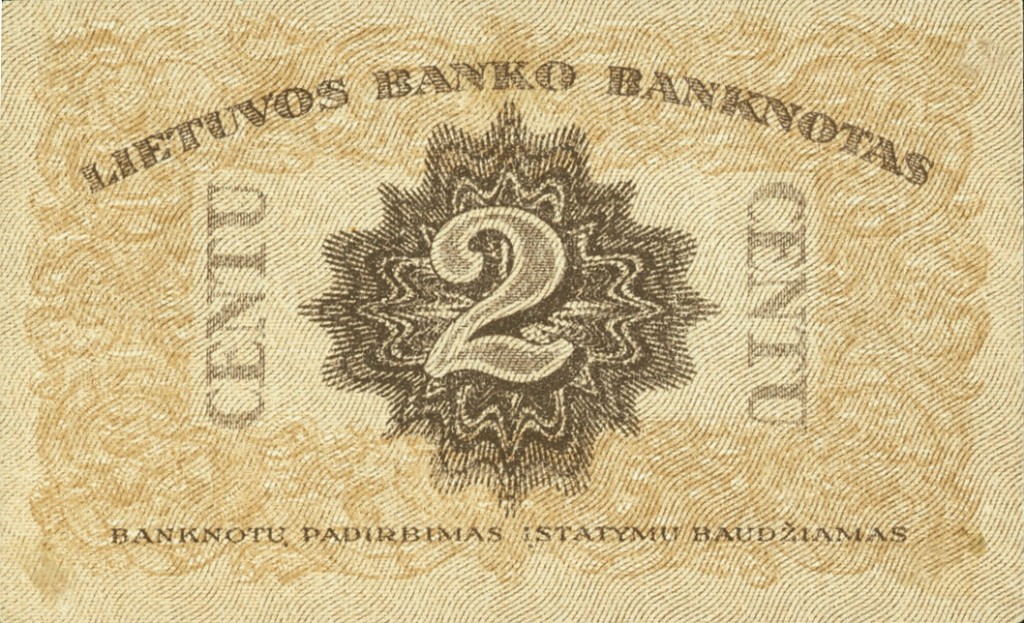
The banknotes of 16 November 1922 issue were printed at the A. Hasse printing house in Prague. The agreement was signed on 29 August 1922. The centas banknotes appeared in circulation at the beginning of November and litas – at the end of 1922–early 1923. The designs of the litas banknotes were designed by the artist A. Varnas who headed the commission supervising the printing in Prague.

In 1924, the Bank of Lithuania decided to issue banknotes worth 500 and 1,000 litas. The designs of the banknotes were revised at the meeting of the General Board of the Bank on 10 November 1924. The meeting on 11 December 1924 decided that the pattern by V. Jomantas and A. Galdikas was to be used, bearing the date of the meeting. The banknotes were printed at the printing house of Bradbury, Wilkinson & Co. Ltd., in accordance with the agreement signed on 11 February 1925. 500 litas banknotes came into use on 28 September 1925, and 1,000 litas – on 23 January 1926. The customer was clearly satisfied with the execution of the order because all later issues came from the same company.

.jpg)
