
Childhood and youth
Augustinas Voldemaras was born on 16 April 1883 in Dysna (Tverečius), to a small peasant family. It is believed that his great-grandfather was a French nobleman from Warsaw, who stayed in Švenčionys after Napoleon’s campaign and married a Lithuanian woman. In interwar society, Voldemaras was presented as a third generation Lithuanian.
His parents were able to let their son go to the three-class school in Tverečius and later in Švenčionys, after which he worked in the office of Daugėliškis district. In 1900, Voldemaras went to visit his brother Pranas, who lived in St. Petersburg, but his brother’s help was not enough, and he was taken under the patronage of Aleksandra and Eduardas Volteriai, as were many Lithuanian schoolchildren and students of that time. Kazimieras Būga, whom he met in St. Petersburg, taught Voldemaras to write correctly in Lithuanian, and in 1901, the future President of Lithuania, Antanas Smetona, was hired to conduct exams at the high school. The two became friends but later Voldemaras became his political opponent.
Policy
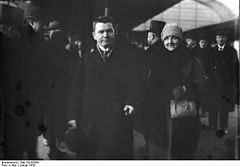 In 1904, he graduated from the St. Petersburg High School with a gold medal, five years later — the Faculty of History and Philology of the University of St. Petersburg with the highest honours, and in 1911 — the University of St. Petersburg awarded him the degree of associate professor. Prior to this, no Lithuanians had ever before received such a high degree in Russia. Voldemaras was famous for his talents outside the university — he had a good memory, eloquence, and was a real erudite and polyglot. After internships in Italy and Switzerland, he received the post of Extraordinary Professor at the University of Perm. Since 1907 he collaborated in “Viltis,” edited by A. Smetona, participated in the activities of the Lithuanian Scientific Society, was one of the founders and members of the National Progress Party, its representative at the Russian Lithuanian Seimas in Petrograd from 27 May to 3 June 1917. Voldemaras had been socially conscious since his youth and always supported the idea of Lithuania’s independence.
In 1918, he returned to Lithuania and joined the Council of Lithuania. On 11 November 1918, the Presidium of the Council of State approved the Government, with Voldemaras appointed to head it. However, his government lasted only one and a half months. In 1919, at the Versailles Peace Conference, he was a representative of the Lithuanian delegation, worked in various Lithuanian governments until 1920, became a professor at the University of Lithuania in 1922, and wrote a lot in the press on political, social, and cultural issues. He was imprisoned in Varniai Labour Camp for an article in the nationalists magazine “Vairas,” which criticised the government of the time. After the 1926 coup, he was a close comrade of President Smetona, served as prime minister and foreign minister, and for a year — the Minister of National Defence. He was awarded three Orders of the Cross of Vytis for his contribution to the creation of the Lithuanian state. But his friendship with Smetona did not last long, and three years later their paths separated. President Smetona, waiting for the favourable situation when Voldemaras was in Geneva, removed his political rival — on 19 September 1929, all the members of the Government resigned, and Smetona commissioned a new government to be formed by his brother-in-law, J. Tūbelis. Voldemaras was removed from power not for his own views, it was more related to the power struggle — these two great men of the state couldn’t help but compete.
 Augustinas Voldemaras at the Palace of the Bank of Lithuania
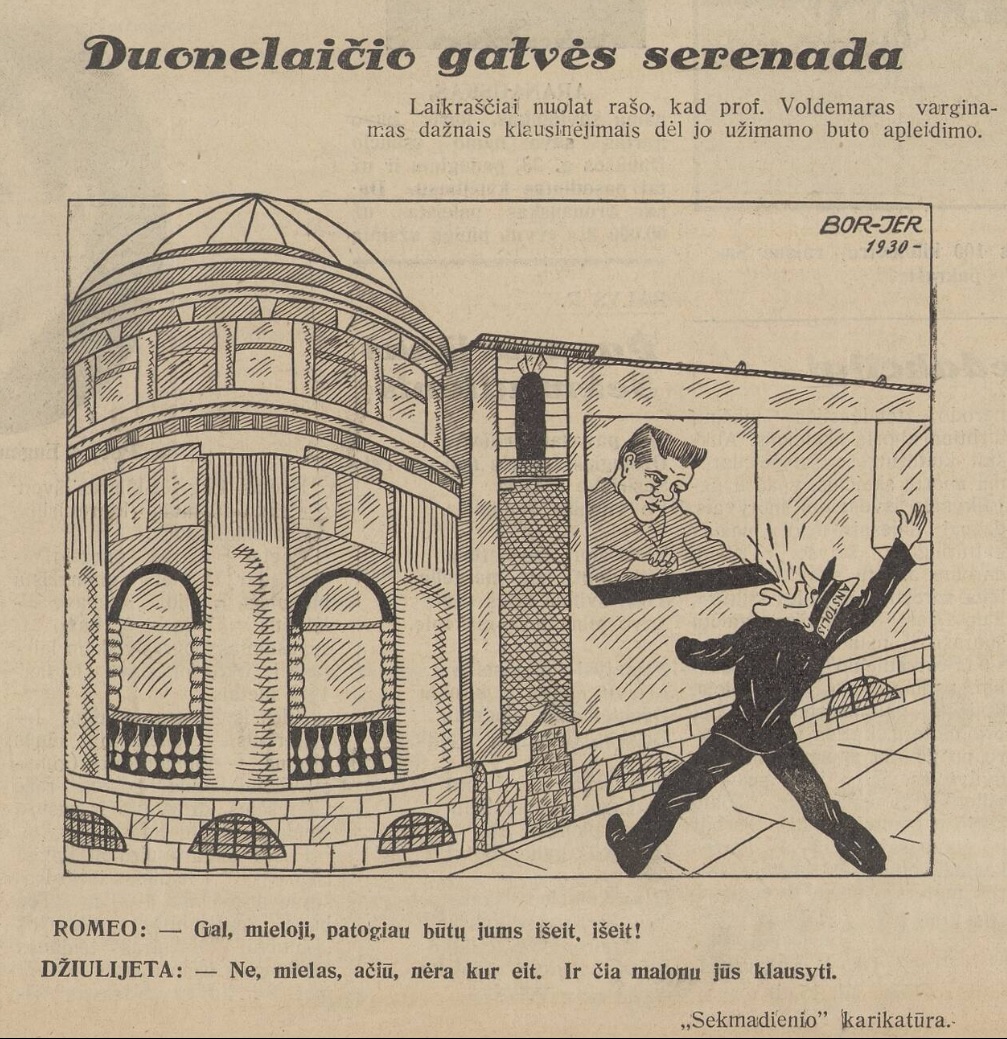
When he retired from power and became an ordinary citizen, Voldemaras had a “primary concern” — to leave the apartment in the building of the Bank of Lithuania in Kaunas, where he could live only as a representative of the Government, and find a private one. The politician did not want to leave this house — it was spacious and luxurious, with eight rooms, including a sumptuous guest reception room, an office, and a library. Voldemaras himself said that a “soothsayer” a couple of years ago told him that he would be able to believe in his future as long as he was living in the building of the Bank of Lithuania. Setting up the apartment and the provision of the furniture cost LTL 200,000. The estimate of the bank’s income also provided for LTL 30,000 in annual lease payments, but neither the Government nor Voldemaras paid it. The Deputy Governor of the Bank of Lithuania, J. Paknys, was convinced that “the bank’s attitude was that the rent will be paid because the apartment was not rented to a private person but to the prime minister. The Government will have to pay the bank.” This apartment in Kaunas was the source of numerous rumours, the press wrote about it a lot, and even abroad the history of this apartment was interesting to the public. In July 1930, Voldemaras was finally evicted from the apartment in the building of the Bank of Lithuania “as a danger to public order and peace” and he was exiled to Plateliai, to the manor of the Counts Šuazel, while his furniture, things, and books were moved out after his departure. However, even in exile, Voldemaras caused a scandal, demanding LTL 5 million from the administration of Kaunas Municipality for his books and antiques being damaged during the move.
Further life
At the time, his supporters, who called themselves “Voldemarists” and never reconciled with Voldemaras never returning to major politics, prepared coups against President Smetona’s rule. It has not been proven that Voldemaras himself contributed to the organisation of these plots. After a failed military coup on 7–8 June 1934, Voldemaras himself was sentenced to 12 years of heavy labour in prison and was imprisoned at the Utena detention house. Amnesty was granted in 1938 on the condition that he go abroad — Smetona wanted him to be as far away as possible from the Voldemarist movement.
After the Soviet Union occupied Lithuania, Voldemaras and his wife returned to Lithuania on 19 June 1940. They were immediately arrested by the Soviets and accused of acting against the Lithuanian State. Before the war, he lived in exile in Orjonikidze, where he was followed and provoked constantly, and later he was taken to Moscow, where he was interrogated to force him to confess that he was acting for German intelligence. On 16 December 1942, he died in Moscow’s Butyrka Prison Hospital, while that same year, his wife Matilda Delahay-Voldemarienė died in Kislovodsk prison on 25 August.
A cenotaph of Augustinas Voldemaras was unveiled in the pantheon of Kaunas Petrašiūnai Cemetery in 1912 — a symbolic tombstone monument to honour the deceased whose grave or burial place is unknown.
By the way, did you know that you can walk around the former apartment of Voldemaras without even leaving your home? You can do this in a virtual tour here.
