
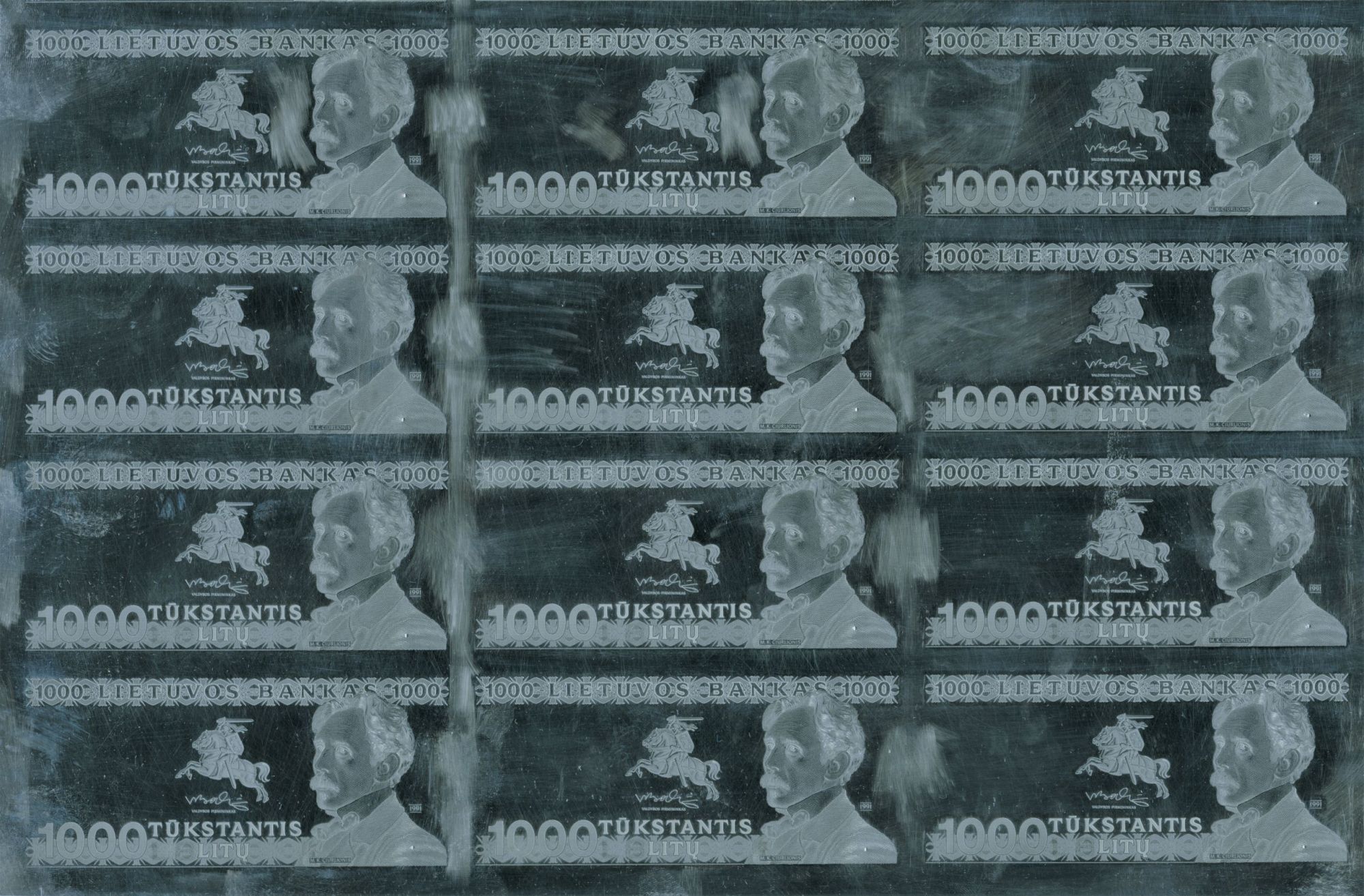
 Perhaps one of the most eloquent relics of this not-quite-pleasant story is the means of producing a 1,000 litas banknote — a gravure printing plate. On this metal sheet, used to print banknotes — we can see dozens of images of banknotes that have never been in circulation. The reason why? They were not used for settlements because of their poor quality.
 In 1990, as the work of litas banknote development accelerated, it was necessary to address not only design but also banknote production issues. The idea of a domestic money printing house was rejected, considering the excessive cost of maintaining it, so a production partner had to be found abroad. Although initially there was no shortage of candidates, two favourites emerged in the long run: François Charles Oberthur, a French company, and the United States Banknote Corporation (USBC). When the Bank of France declared at the end of October 1990 that the political situation prevented it from crediting banknote production, a contract was signed with the Americans at the end of December 1990.
However, just as the signed agreement was being implemented, serious disruptions took place. The events of January 1991 delayed the opening of a letter of credit account, through which the USBC was supposed to be paid for the production of banknotes. On this basis, the Americans requested a postponement of the deadline for the delivery of banknotes. The Bank of Lithuania agreed to do so and the first printed litas (10, 20, and 50 litas) reached Lithuania only in November 1991. It immediately became clear that the banknotes were of poor quality. On 30 August and 17 September 1992, several examinations were carried out, the results of which were astonishing — it turned out that the 10, 20, and 50 litas banknotes could easily be counterfeited, while the use of larger denominations (100, 500, and 1,000 litas) in circulation could only be possible for a limited period of time. Nevertheless, the company was given the opportunity to fix the situation — reprint the unsuitable banknotes. It did so in 1993, but these banknotes were also not without reproach. On 5 August of the same year, a memorandum was signed with USBC, providing that if the company presented a high-quality product, it would be given the exclusive right to conclude contracts for the printing of other banknotes for a period of 36 months. On 21 March 1994, the last shipment of 50 litas banknotes of 1993 issue was received.
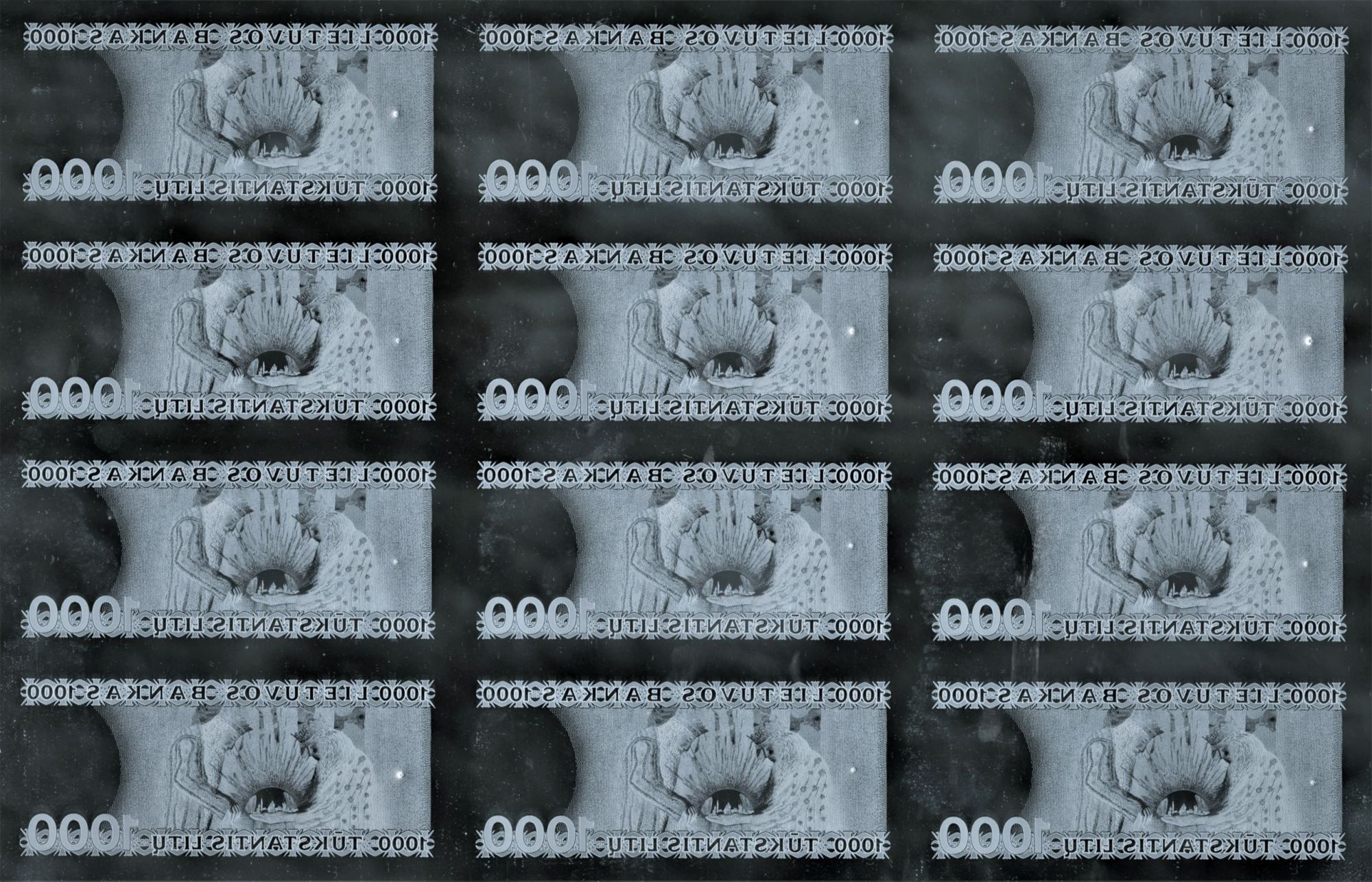 However, having had an unpleasant experience with USBC, the Bank of Lithuania decided to settle in full, i.e. asking for the repayment of the advance and returning the production facilities. However, the company, which later turned out to be having a tough time, sought to keep the Bank of Lithuania as its client and delayed the process. Poor quality banknotes were supposed to serve the interests of the American company — due to rapid wear, they would have to be reprinted in less than three years, which, according to the memorandum, would have been done by the same USBC. In 1995, it became clear that exactly this scenario was a serious risk, so on 18 April 1996, a few months before the end of the period laid down in the memorandum, the Bank of Lithuania launched a new tender for the production of banknotes. Despite efforts by USBC, which was now known as the American Banknote Corporation (ABC), to convince the Bank of Lithuania that it was ready to produce new banknotes, Reinoldijus Šarkins, Chair of the Board of the Bank of Lithuania, informed ABC on 22 November 1996 that the agreement would not be concluded with them. International court proceedings were opened, which only ended on 30 August 2004.
 The recovery of the means of production of the litas, such as this plate, was only one, but a rather pronounced episode in the history of relations between the Bank of Lithuania and the American corporation. In mid-1997, the Bank of Lithuania applied to ABC to request the transfer of its legally owned banknote production facilities. The Bank’s specialists had reasonable suspicions that they could be stored unsafely or even destroyed. For their part, the Americans did not want to do so, on the grounds that the Bank of Lithuania could transfer the means of production to third parties. According to Mindaugas Vinkus, who studied the history of litas printing, this move by the Bank of Lithuania in the case was partly tactical because it aimed to show American negligence not only in the production of banknotes but also in the protection of the means necessary for their production. On 25 February 1998, the International Court of Arbitration ordered the American Banknote Corporation to transfer the materials and means of production to a trustee or directly to the Bank of Lithuania. On 16–17 April of the same year, a delegation of the Bank of Lithuania, which arrived in the United States, took over the facilities and found that some of them were missing. There were also pre-emptive fears that these critical items had been poorly secured. This was confirmed by an audit by the Canadian company CAGI. On 24 July 1998, the court ordered ABC to preserve the facilities that had not been returned or not destroyed in accordance with the instructions of the Bank of Lithuania until the end of the legal proceedings. In August, a joint American-Japanese company, Komori Currency Technology U. K. Ltd., also sent 1,000 units of various means of production. Although the number was impressive, in this case not everything had been returned as well.
The ABC trial coincided with the downfall of the company — in 1999, bankruptcy procedures were initiated, and the Bank of Lithuania found itself among the creditors. This cooperation, which cost so much time and effort as we have seen, ended in favour of the Bank of Lithuania. However, there was another “loser” in this story — the 1,000 litas banknote itself. Initially, it was not put into circulation because it was simply too big. Eventually, in the long run, when the need finally arose, it was no longer suitable for security purposes. In January 2005, the Bank of Lithuania decided to destroy these banknotes and leave only 20,000 units for numismatic purposes. Today, it’s a favourite among collectors, and encourages many to ask the question “what if...?”
